
Why Reconstitution Volume Changes Concentration but Never Changes Total Peptide Amount
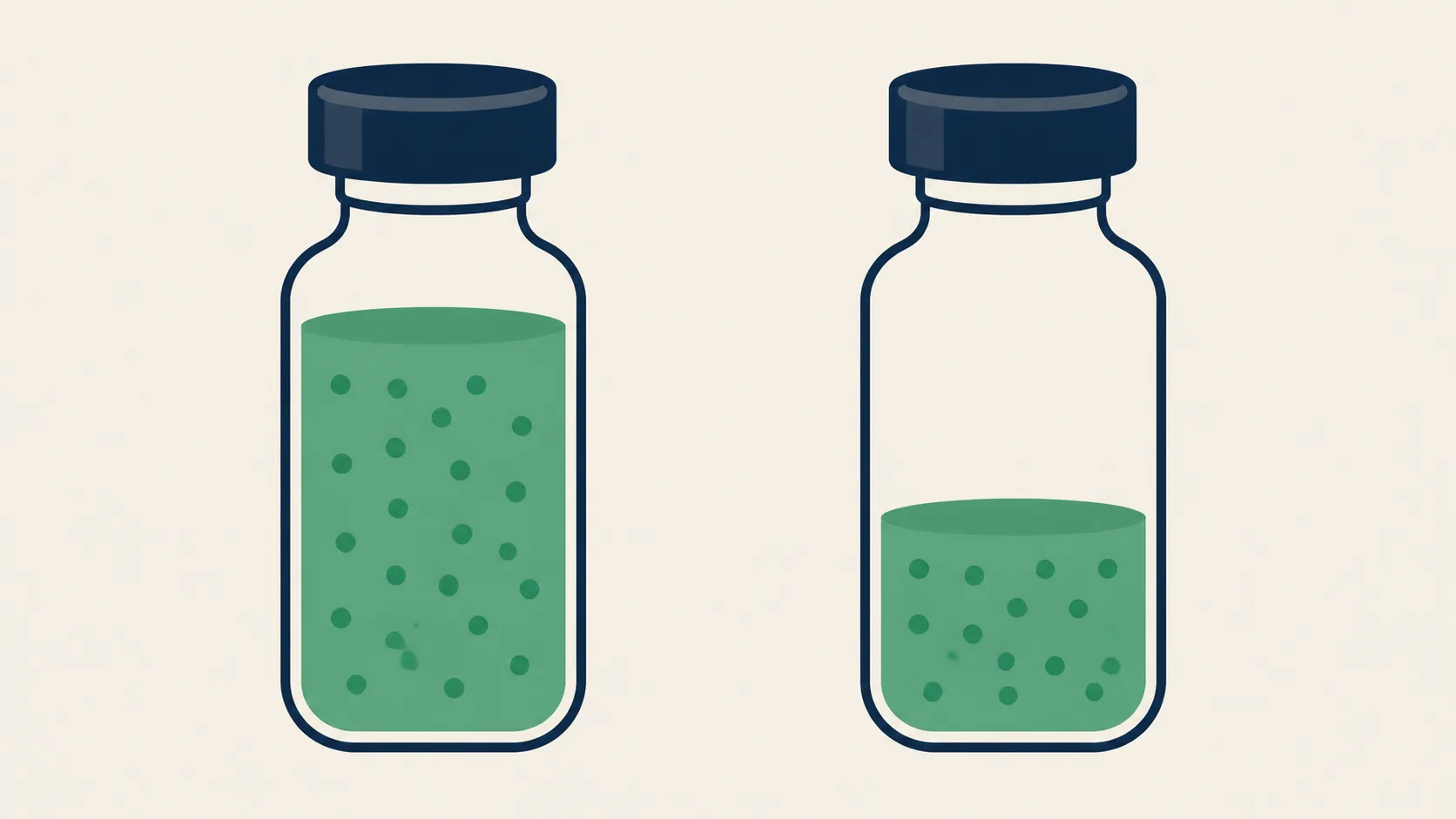
This is one of the most common points of confusion in reconstitution math, and it’s worth stating as plainly as possible: reconstitution volume vs total amount is a distinction between two different numbers. The amount of water you add changes concentration. It does not change how much peptide is in the vial. Our peptide calculator is built around exactly this distinction, which is worth understanding before you rely on any tool’s output.
Total Amount Is Fixed
Total peptide amount is fixed the moment the vial is manufactured. A vial labeled 5 mg contains 5 mg of peptide, full stop — that number was set during manufacturing and doesn’t change based on anything you do afterward. Adding bacteriostatic water doesn’t add or remove peptide; it just distributes that same fixed amount across a larger or smaller liquid volume. This is the core of the reconstitution volume vs total amount relationship: one number moves, the other never does. Drop your vial’s numbers into the peptide calculator and this stays visible at every step.
This is where the confusion usually starts: people sometimes assume adding more water “uses up” or “wastes” some of the peptide. It doesn’t. Every milligram from the original vial is still present in the solution; it’s just less concentrated per milliliter. Nothing is lost in the dilution itself — the peptide amount before and after adding water is identical, only spread across a different volume.
Background: Concentration (chemistry) — the general principle behind amount vs. concentration
What Water Volume Actually Changes
Concentration is the peptide amount spread across whatever water volume you chose — and that’s the number that actually changes. The formula is simple: concentration = total peptide ÷ water volume. Add 1 mL of water to a 5 mg vial and you get 5 mg/mL. Add 2 mL instead, and the same 5 mg is now spread across twice the liquid, giving 2.5 mg/mL — a weaker solution, but still exactly 5 mg of peptide total.
What actually changes as a downstream consequence of concentration: injection volume per dose. A more concentrated solution (less water added) means a smaller volume delivers the same dose; a more dilute solution (more water added) means a larger volume is needed for that same dose. This is why choosing reconstitution volume is really a choice about injection volume and syringe precision, not a choice about how much total peptide you’ll get to use — that total was locked in at the vial’s label from the start.
A practical implication: if a calculated injection volume comes out awkwardly small (hard to measure precisely on your syringe) or awkwardly large, adjusting reconstitution volume — not the vial itself — is the correct lever to pull, since it changes concentration and therefore injection volume without touching total peptide amount at all.
Reconstitution Volume vs Total Amount, at a Glance
- Total peptide amount: Fixed at manufacturing (e.g. 5 mg) — never changes, no matter how much water you add.
- Concentration: Total peptide ÷ water volume — this is what reconstitution volume actually controls.
- More water added: Lower concentration, larger injection volume per dose — same total peptide.
- Less water added: Higher concentration, smaller injection volume per dose — same total peptide.
Our peptide calculator updates concentration and injection volume live as you adjust the water amount, making this relationship visible in real time rather than something you have to hold in your head.
Tracking measurements accurately over time is a theme across the site — our Age & Life Calculators cluster →
Peptide Calculator
Run the actual numbers free, no signup required.
Related questions
Can I use tap water instead of bacteriostatic water to reconstitute a peptide?
No — tap water isn’t sterile and contains no preservative, which risks contamination and shortens usable stability dramatically. Bacteriostatic or sterile water, specifically labeled for reconstitution, is the standard for a reason.
How long does a reconstituted peptide stay stable once mixed?
It depends heavily on the specific compound and storage conditions, but many reconstituted peptides are considered stable for a period of weeks when refrigerated — always check the vial-specific guidance rather than assuming a universal timeframe.
Does reconstitution volume vs total amount ever actually change the dose I’m getting?
No — as long as the math is done correctly, total peptide amount stays fixed regardless of reconstitution volume. What changes is injection volume, which is why accurate concentration calculation matters more than the water amount itself.