
Reading a U-100 Insulin Syringe: A Plain-English Guide to the Markings
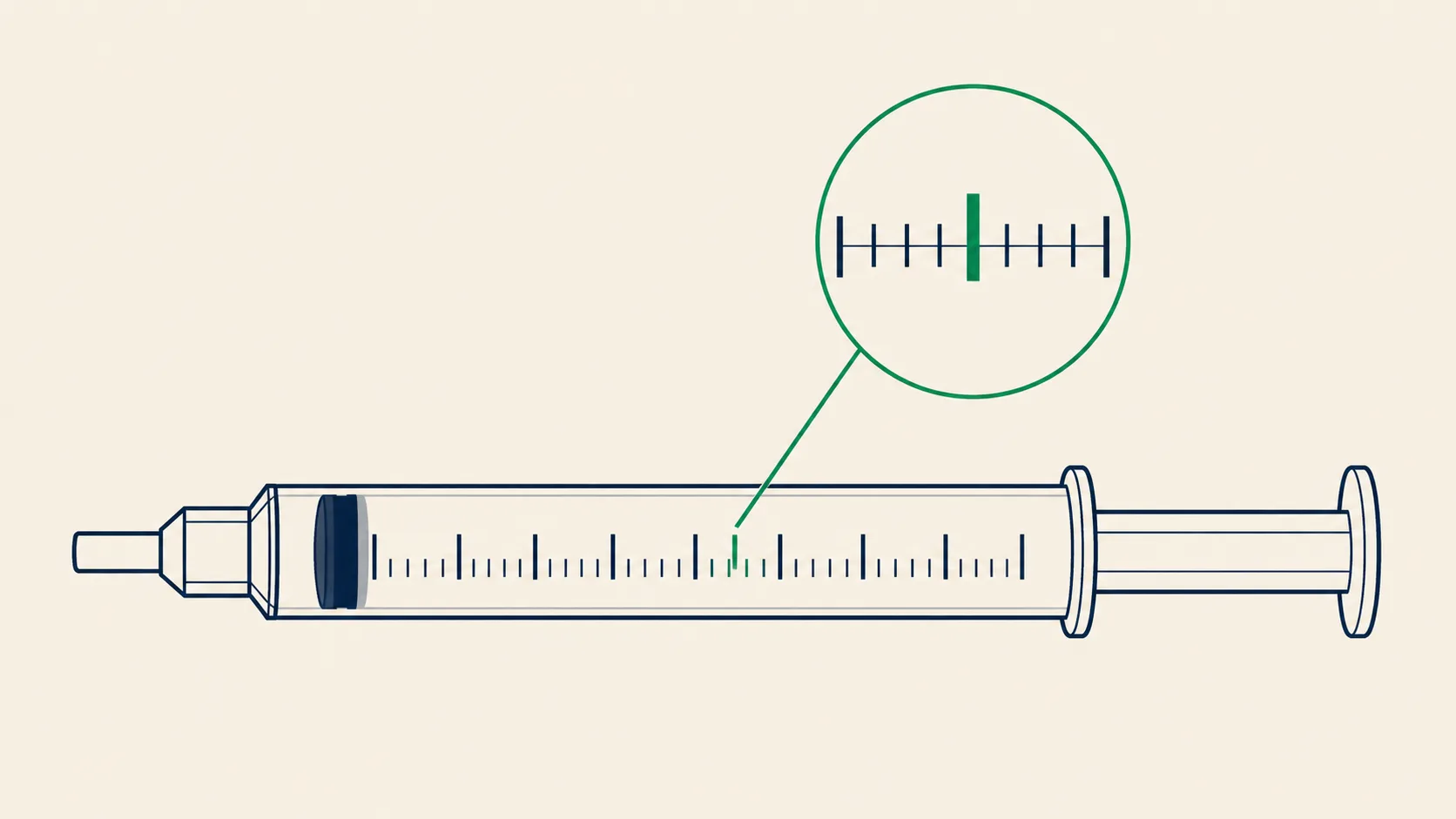
Learning how to read a U-100 insulin syringe is simpler than it looks once you know what the lines on the barrel actually represent. Insulin syringes look deceptively simple — a barrel with lines on it — but the numbering system behind those lines confuses a lot of first-time users, mostly because the markings aren’t in a unit most people think in day to day.
What “U-100” Actually Means
“U-100” describes the syringe’s calibration, not its physical size. It means the syringe is calibrated on the assumption that the solution inside it is concentrated at 100 units per milliliter. That’s a historical convention from insulin dosing, where “units” refers to a standardized potency measure — but the syringe itself doesn’t know or care what solution is actually inside it. It’s just a ruler marked in a specific way.
U-40 syringes still exist too, calibrated for 40 units per mL instead of 100. Mixing the two up — reading a U-40 syringe as if it were a U-100, or vice versa — is one of the most common real-world dosing errors, which is exactly why manufacturers are required to print the calibration directly on the barrel rather than leaving it to assumption. Part of learning how to read a U-100 insulin syringe is simply confirming, every time, that the barrel in your hand is actually the U-100 type before you trust any of its lines.
How to Read a U-100 Insulin Syringe: The Core Conversion
The core conversion to remember: on a U-100 syringe, 100 units = 1 mL. That means every marked unit represents 0.01 mL. A syringe reading of 10 units is 0.10 mL; 50 units is 0.50 mL; 25 units is 0.25 mL. The unit markings are just a finer-grained way of reading small volumes than milliliter markings alone would allow, since 0.01 mL increments are hard to read accurately on a plain mL scale at this size.
The table below is a fast way to practice how to read a U-100 insulin syringe without doing the mL math in your head every time:
| Units | Milliliters (mL) | Typical context |
|---|---|---|
| 5 units | 0.05 mL | Micro-dose |
| 10 units | 0.10 mL | Low-end dose |
| 25 units | 0.25 mL | Quarter-mark on a 1 mL syringe |
| 50 units | 0.50 mL | Full 0.5 mL syringe |
| 75 units | 0.75 mL | Three-quarter mark on a 1 mL syringe |
| 100 units | 1.00 mL | Full 1 mL syringe |
Syringe barrel sizes vary even within U-100 syringes — a common size holds up to 50 units (0.5 mL) total, while a smaller size might max out at 30 units. The unit-to-mL conversion ratio stays identical across these sizes; what changes is simply how much total volume the barrel can hold before running out of markings.
Common Misreading Mistakes to Avoid
A common point of confusion: unit markings do not directly tell you a dose in mg or mcg — they only tell you volume. The dose only becomes meaningful once you know the concentration of what’s in the syringe, since the same 10-unit draw represents a completely different peptide amount depending on how concentrated the solution is. This is why concentration has to be calculated correctly before the syringe reading means anything at all.
Double-checking your specific syringe’s printed scale before drawing is worth the extra ten seconds every time — not every syringe on the market is U-100, and using a different calibration’s markings against a U-100 assumption produces a real error. This is also why U.S. regulators require the barrel itself to carry the calibration statement: FDA guidance for insulin syringes specifies that the barrel must be printed with the legend “For use with U100 insulin only,” precisely so the calibration isn’t left to guesswork at the point of use.
Source: FDA — Premarket Notification Guidance for Piston Syringes
Our peptide calculator converts your calculated injection volume directly into syringe units for the specific syringe size you select, so you’re reading a number that already accounts for your syringe’s actual calibration — one less thing to work out manually once you already know how to read a U-100 insulin syringe.
Tracking measurements accurately over time is a theme across the site — our Age and Life Calculators cluster →
Peptide Calculator
Run the actual numbers free, no signup required.
Related questions
How to read a U-100 insulin syringe accurately?
Line up the flat top edge of the plunger’s rubber stopper — not the rounded middle — with the unit marking you want, and view it at eye level to avoid a skewed reading. Since 100 units equals 1 mL on this syringe type, each individual line typically represents 1 or 2 units depending on the barrel size.
What’s the fastest way to learn how to read a U-100 insulin syringe?
Memorize the one ratio the whole scale is built on — 100 units = 1 mL — then use the quick-reference table above until reading the barrel becomes automatic. Almost every other question about the markings traces back to that single conversion.
Can I use tap water instead of bacteriostatic water to reconstitute a peptide?
No — tap water isn’t sterile and contains no preservative, which risks contamination and shortens usable stability dramatically. Bacteriostatic or sterile water, specifically labeled for reconstitution, is the standard for a reason.
How long does a reconstituted peptide stay stable once mixed?
It depends heavily on the specific compound and storage conditions, but many reconstituted peptides are considered stable for a period of weeks when refrigerated — always check the vial-specific guidance rather than assuming a universal timeframe.
What does a Certificate of Analysis (COA) actually verify?
A COA is a lab document confirming a specific batch’s actual purity and identity as tested — it’s evidence of what’s in a given vial, not a guarantee about any other batch, which is why matching the COA to the specific lot number matters.