
mg vs mcg: The Unit Mistake That Throws Off Every Reconstitution Calculation
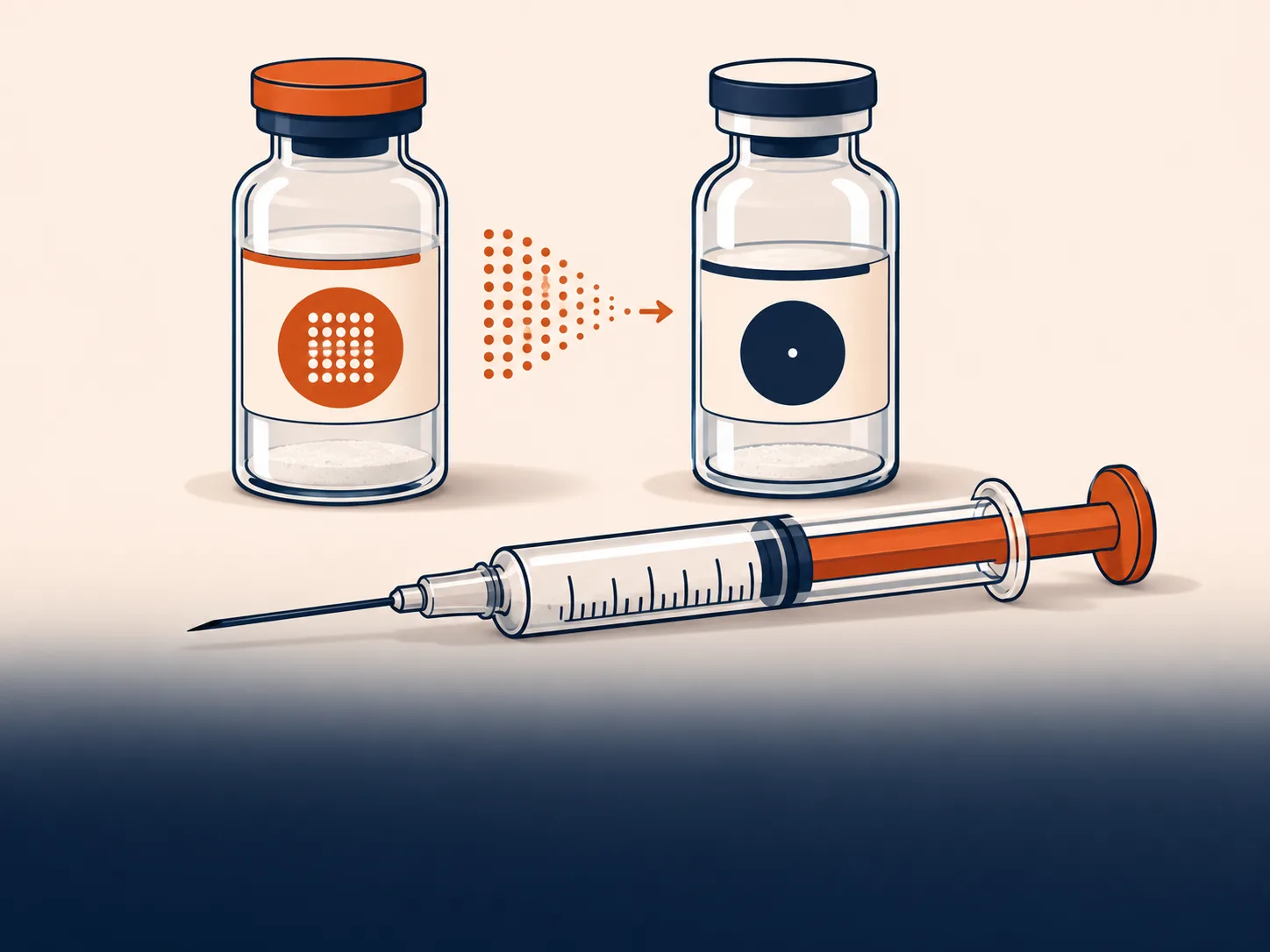
The mg vs mcg mix-up is the single most common mistake in peptide dosing, and it isn’t a small error — it’s a 1,000x error, hiding behind two abbreviations that look almost identical on a label.
What mg vs mcg Actually Means
The relationship is fixed and simple: 1 mg = 1,000 mcg. That’s the entire rule. The problem isn’t the math — it’s that vial labels, calculator inputs, and dosing protocols don’t always use the same unit, and switching between them silently is where mistakes creep in. Running the numbers through a tool that shows both units at once, like our peptide calculator, is one of the simplest ways to catch a mismatch before it reaches a syringe.
Here’s the pattern that trips people up most often. A vial is labeled in milligrams (say, 5 mg), because that’s how peptide is typically packaged and sold. But the actual dose people are working toward is usually described in micrograms (say, 250 mcg), because doses are small enough that milligrams would mean writing a lot of decimal places. So the moment you go from “how much is in the vial” to “how much is in one dose,” you’ve crossed a unit boundary — and if that conversion happens in your head instead of on paper, it’s very easy to drop or add a zero without noticing.
This 1,000x relationship isn’t specific to peptides — it comes from the SI system of units itself. According to the U.S. National Institute of Standards and Technology, the “milli” prefix always means one-thousandth of a base unit, while “micro” means one-millionth — a fixed 1,000x gap between the two, in any measurement context, not just dosing.
Source: NIST — Metric (SI) Prefixes
Where the mg vs mcg Mistake Causes Real Damage
Where this actually causes damage is in the concentration step, not the dose itself. Once a vial is reconstituted with bacteriostatic water, the concentration is peptide amount divided by water volume — and if the peptide amount was mistakenly entered as 5 mcg instead of 5 mg (or vice versa), every downstream number is wrong by a factor of 1,000: concentration, injection volume, syringe units, total doses per vial, all of it. The syringe reading might still look plausible on the surface, which is exactly why the error is dangerous — nothing about a “10-unit draw” looks obviously wrong even when the underlying math was off by three orders of magnitude.
A simple habit prevents almost all of this: convert everything to one unit before you touch a syringe, and write it down. If your vial says milligrams and your target dose is in micrograms, convert the dose to milligrams (or the vial amount to micrograms) as a separate, visible step — don’t let the conversion happen silently in your head between two fields. Getting mg vs mcg right at the labeling stage prevents nearly every downstream error.
Quick Reference Table
| Milligrams (mg) | Micrograms (mcg) | Typical context |
|---|---|---|
| 0.1 mg | 100 mcg | Low-end single dose |
| 0.25 mg | 250 mcg | Common single dose |
| 0.5 mg | 500 mcg | Mid-range single dose |
| 1 mg | 1,000 mcg | Reference unit |
| 2 mg | 2,000 mcg | Small vial size |
| 5 mg | 5,000 mcg | Common vial size |
| 10 mg | 10,000 mcg | Larger vial size |
This is also the exact reason a good reconstitution tool displays both units side by side rather than picking one. Our peptide calculator shows concentration in both mg/mL and mcg/mL simultaneously, specifically so a unit mismatch becomes visible before it reaches a syringe rather than after.
Tracking measurements accurately over time is a theme across the site — our Age & Life Calculators cluster →
Peptide Calculator
Run the actual numbers free, no signup required.
Related questions
Why is mg vs mcg such a common mistake in peptide dosing?
Because the two abbreviations look nearly identical on a label but represent a 1,000x difference in amount, and because vials are typically labeled in milligrams while doses are typically described in micrograms — the conversion step is where the error creeps in.
How do I read the markings on a U-100 insulin syringe?
A U-100 syringe is calibrated so that 100 units equals 1 mL of solution. Each small marking typically represents 1 or 2 units depending on the syringe size, and the exact unit reading for any dose depends entirely on your mixed concentration.
Does changing the reconstitution volume change the total amount of peptide in the vial?
No — it only changes the concentration (how much peptide is in each mL), never the total amount of peptide originally in the vial. More diluent means a more dilute solution, not less total product.
What do common peptide abbreviations like BPC-157 or TB-500 actually refer to?
These are shorthand names for specific peptide compounds used in research contexts, not brand names or dosing instructions — the abbreviation identifies the compound itself, separate from any reconstitution or dosing decision.