
How Kabbalists Used Letter-Values to Read Hidden Meaning Into the Torah
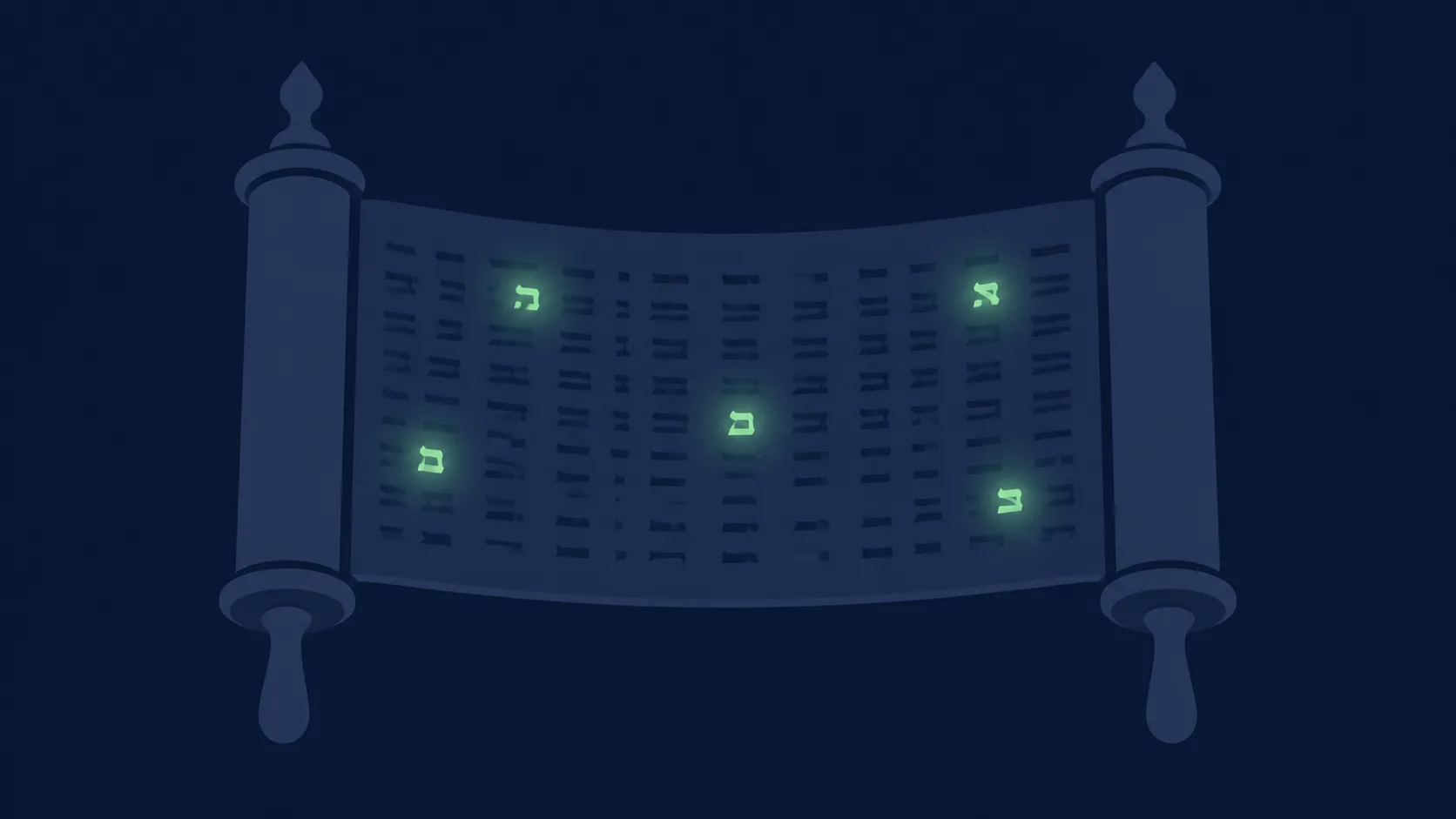
Gematria didn’t stay a simple counting exercise for long. Its most elaborate use came through Kabbalah, the Jewish mystical tradition, where scholars treated the Torah’s letters as containing layers of meaning well beyond their literal reading.
What Kabbalah Gematria Actually Claims
The core idea behind Kabbalah gematria was that if two words or phrases summed to the same numeric value, that match wasn’t considered coincidental. In a tradition that already treated every letter of scripture as intentional, a shared gematria value between two seemingly unrelated verses was read as evidence of a hidden connection the plain text didn’t announce on its own.
One of the most cited examples involves the Hebrew word for “serpent” and the Hebrew word for “Messiah,” both of which reduce to the same gematria value under the standard Hebrew system — a numeric echo that Kabbalistic commentary treated as meaningful precisely because it wasn’t obvious from reading either word alone.
Background: Kabbalah — Wikipedia
Why Kabbalists Matched Torah Words by Number
This practice sat inside a larger Kabbalistic framework that treated the Torah’s text — including letter shapes, spacing, and numeric values — as containing information beyond its surface narrative. Gematria was one tool among several (alongside notarikon and temurah, other letter-manipulation techniques) used to extract that additional layer. For a look at how a related system diverges numerically, see our Hebrew Standard gematria breakdown, since Kabbalistic gematria specifically relies on that system.
It’s important to be clear about what this is and isn’t. Kabbalistic gematria is a genuine, centuries-old interpretive tradition — but it’s an interpretive one, not an empirical method. The numeric matches it identifies are real arithmetic, but the meaning assigned to those matches comes from the tradition’s framework, not from any provable property of the numbers themselves.
Why this still shows up in modern gematria calculators is that the underlying Hebrew Standard system — Aleph through Tav mapped to their historical values — is exactly the system Kabbalists were using. Anyone running a Hebrew word through a calculator today is using the same numeric foundation those scholars worked from centuries ago, even if the interpretation applied to it is much more casual now.
Kabbalah Gematria at a Glance
- Gematria: Numeric value matching between words — the technique this article covers.
- Notarikon: Treating a word’s letters as an acronym for a longer phrase.
- Temurah: Letter substitution and permutation to reveal alternate readings.
- Dominant system: Hebrew Standard (Mispar Hechrachi), the historical Aleph-to-Tav mapping.
Our gematria calculator includes the authentic Hebrew Standard mapping alongside a written interpretation library for common resulting numbers, so you can see both the calculation and the traditional meaning associated with it in one place.
Numbers show up everywhere on this site, not just in letter-values — our Age & Life Calculators cluster →
Gematria Calculator
Run the actual numbers free, no signup required.
Related questions
Is gematria a religious practice or just a linguistic curiosity?
Both, depending on who’s using it. Within Jewish scholarship it’s a genuine tool for Torah study; outside that context, plenty of people use the same arithmetic purely as a numerological curiosity with no religious framing attached.
Why do Kabbalists care about a word’s numerical value?
Kabbalistic tradition treats matching gematria values as evidence that two words or phrases share a deeper conceptual connection — the numbers are read as a layer of meaning embedded in the text itself, not just coincidence.
Is there a “correct” gematria system to use for serious study?
For traditional Torah study, Hebrew Standard (Mispar Hechrachi) is the historically dominant system. Outside that specific context, the right system depends entirely on which tradition or language you’re working with.