
A Short History of Isopsephy — How the Greeks Counted Letters Before the Rabbis Did
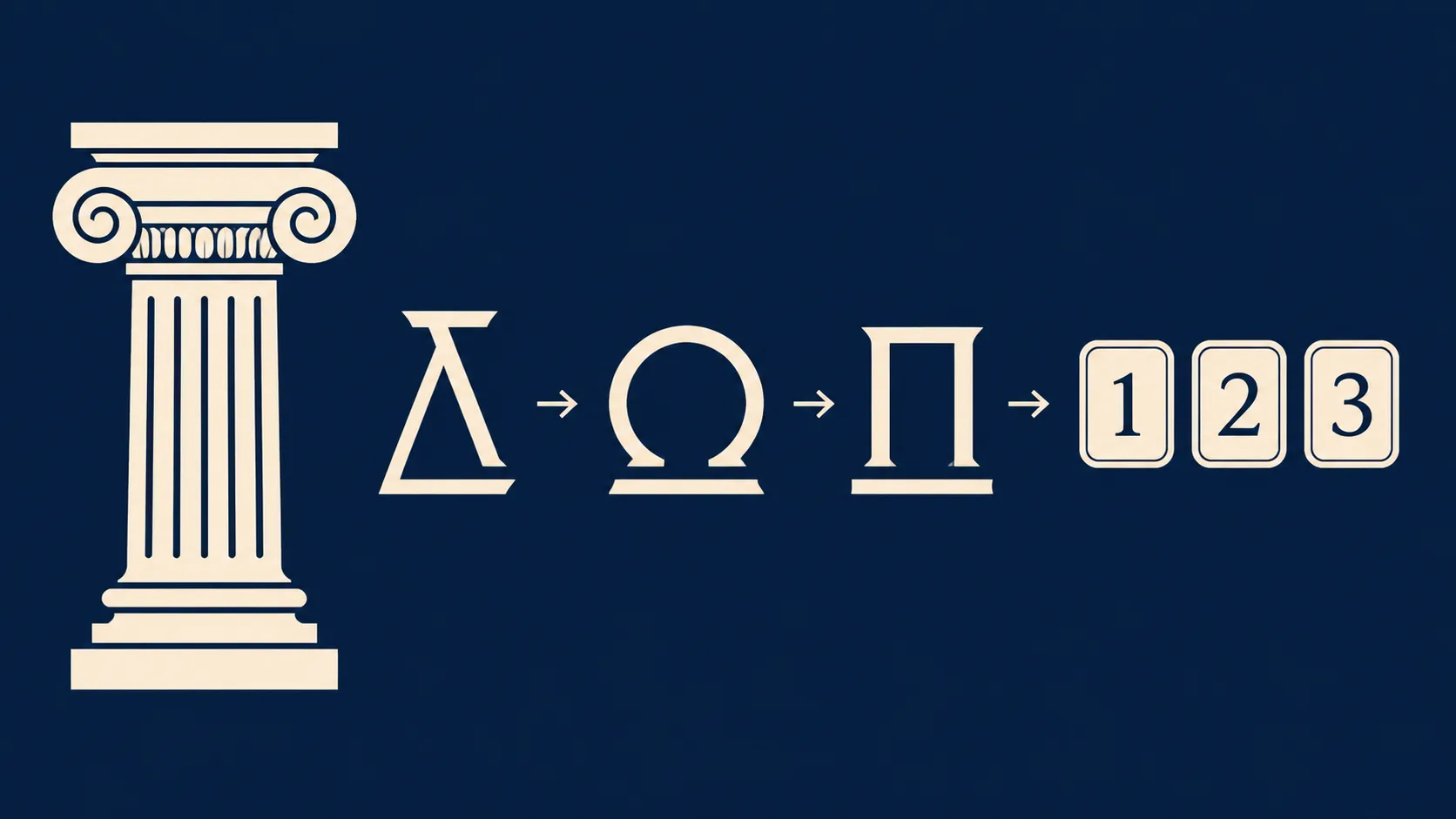
Isopsephy history is usually told as a footnote to gematria’s, but the two traditions actually developed side by side, in different alphabets, for different audiences. Gematria gets framed as the Jewish system — Hebrew letters standing in for numbers, used by rabbis to find hidden connections in scripture. Isopsephy is its Greek counterpart, built on exactly the same idea: every letter of the alphabet doubles as a number, so every word is secretly also a sum.
Isopsephy History: Where It Actually Starts
The name itself explains the concept: isos means “equal,” psephos means “pebble” — a reference to the pebbles used for counting and voting in the ancient world. Two words are “isopsephic” if their letters add up to the same total, the same way two piles of counting-pebbles can hold an equal number of stones without looking alike.
The system traces back to the Milesian numbering scheme, developed in the Greek city of Miletus, and Aristotle himself associated it with the Pythagorean tradition that originated around the 6th century BCE. That timing matters: it puts isopsephy’s roots in roughly the same broad era as the earliest documented use of Hebrew letters as numbers, rather than one system copying the other centuries later.
Source: Wikipedia — Isopsephy
Isopsephy vs. Gematria: Related, Not the Same
The two systems are cousins, not the same tradition wearing different letters. Gematria is specifically the Hebrew practice, closely tied to Talmudic and later Kabbalistic scholarship, where matching numeric totals were read as evidence of a deeper textual connection. Isopsephy did the same arithmetic in Greek, but it shows up in a wider range of everyday contexts — graffiti, riddles, and wordplay found on ancient vases and inscriptions, not exclusively religious texts.
Because both systems assign values by each alphabet’s own letter order, a word that’s isopsephic in Greek has no reliable relationship to that same word’s gematria value once translated into Hebrew — the two totals are answering questions in two unrelated numbering systems, the same way a price in dollars and a price in yen aren’t comparable without a separate conversion step.
The 666 Connection
Isopsephy history’s best-known modern echo shows up in Revelation 13:18 — “let the one who has understanding calculate the number of the beast… his number is 666.” Biblical scholars have long debated what “calculate” was actually asking readers to do, and one widely discussed theory is that it’s pointing directly at this kind of letter-counting: the Greek name “Nero Caesar,” transliterated and summed using gematria/isopsephy-style letter values, is one of the most frequently proposed solutions to the puzzle — though it remains a genuinely contested reading among scholars, not a settled answer.
Source: Christian Research Institute — What Is the Meaning of 666?
Curious what your own name or a word adds up to under this system versus Hebrew gematria? Our gematria calculator runs both side by side, so the difference isopsephy history is actually about becomes visible in your own numbers, not just an abstract historical comparison.
Numbers show up everywhere on this site, not just in letter-values — our Age and Life Calculators cluster →
Gematria Calculator
Run the actual numbers free, no signup required.
Related questions
Is the “Number of the Beast,” 666, based on Hebrew gematria or Greek isopsephy?
It’s genuinely debated. The most cited theory transliterates the Greek “Nero Caesar” and sums it using Hebrew letter values, which technically makes it a gematria calculation built on a Greek name — meaning isopsephy and gematria are both part of the puzzle, not just one or the other. Some early Christian commentators never connected 666 to Nero at all, so this remains one proposed solution among several, not a consensus fact.
What does “isopsephy” literally mean?
It comes from the Greek for “equal pebbles” — isos (equal) and psephos (pebble), referencing the pebbles ancient Greeks used for counting. Two words are isopsephic when their letters add up to the same total.
Did isopsephy come from gematria, or the other way around?
Neither, as far as the historical record shows — they developed independently in their own alphabets around a broadly similar era, rather than one system being copied from the other.
Is isopsephy still used today?
Mostly as a historical curiosity and in numerology communities rather than mainstream scholarship, though it remains a genuine reference point in classical studies and biblical textual criticism, particularly around passages like Revelation 13:18.