
How Long Does Reconstituted Peptide Actually Stay Stable? Storage Basics Explained
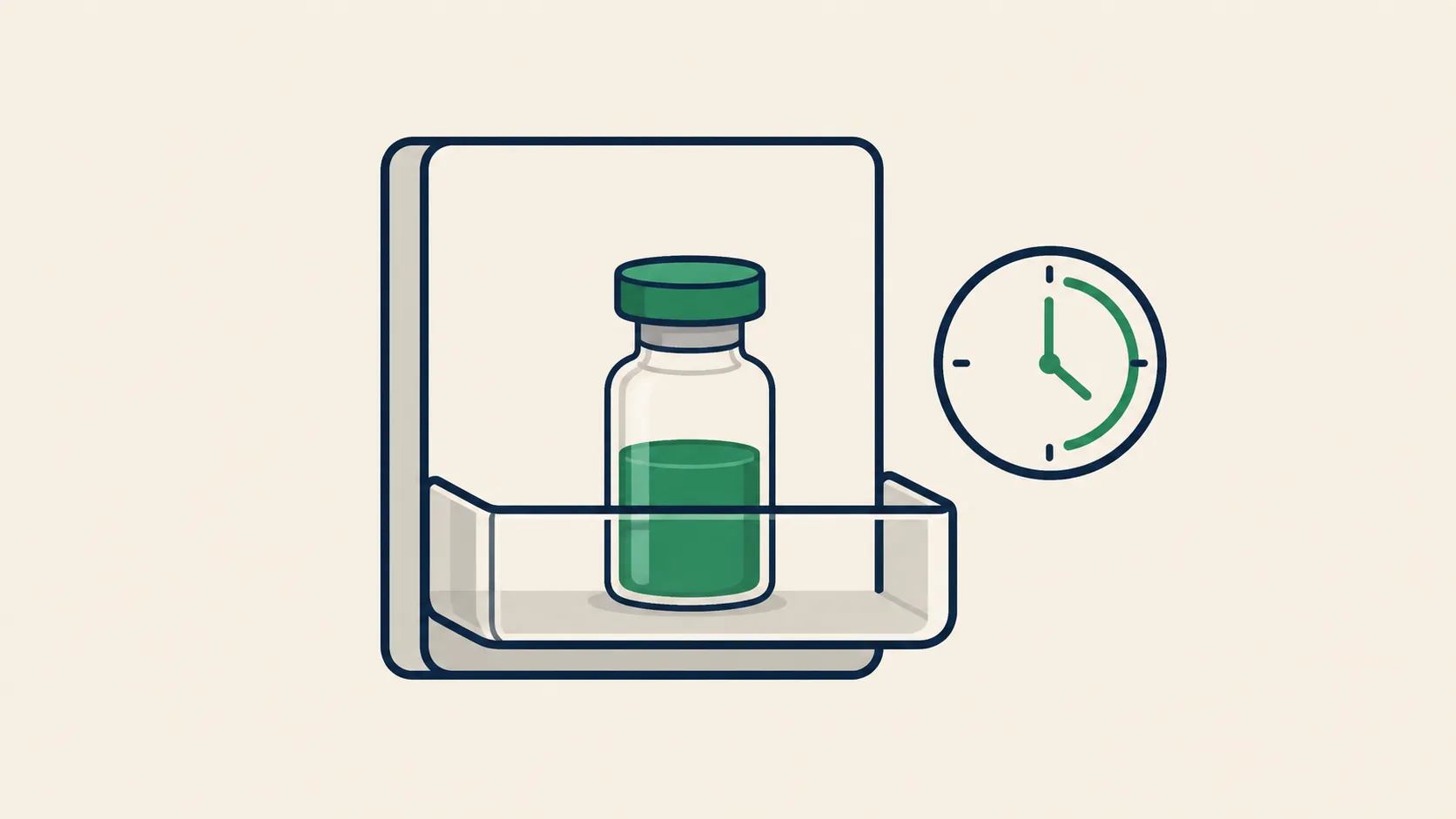
Reconstituted peptide storage works very differently from storing the same peptide as a sealed, freeze-dried powder. A peptide sitting as freeze-dried powder in a sealed vial is remarkably stable, often for a long shelf life under proper storage. The moment bacteriostatic water is added, that stability picture changes — and understanding why helps explain some of the storage guidance that gets attached to reconstituted vials.
Reconstituted Peptide Storage: Why the Clock Starts at Mixing
Freeze-dried (lyophilized) peptide is stable largely because it’s been dehydrated. Most degradation pathways that break peptides down — hydrolysis in particular, where water molecules attack and break peptide bonds — require water to happen at all. Remove the water, and you remove the primary mechanism driving degradation. That’s the whole reason lyophilization is used for peptide storage in the first place.
Reconstitution reintroduces water, and with it, the clock on hydrolysis starts running again. This is why reconstituted peptide has a meaningfully shorter usable window than the same peptide in lyophilized form — commonly cited storage guidance for many reconstituted peptides falls in a roughly 2-to-4-week range under refrigeration, though this varies by specific peptide and should always be checked against that peptide’s own documentation rather than assumed universal.
Peer-reviewed formulation research backs this up directly: peptides in aqueous solution are considerably more prone to hydrolysis, oxidation, and aggregation than the same peptides in solid form, which is precisely why cold-chain storage becomes necessary once a peptide is in solution rather than powder.
Temperature and Light: The Two Levers You Control
Temperature is the single biggest lever after reconstitution. Refrigeration (not freezing, for most reconstituted peptides) slows the rate of hydrolysis and other degradation pathways considerably compared to room temperature storage. Repeated freeze-thaw cycles, meanwhile, can introduce their own stress on peptide structure through ice crystal formation, which is why “just freeze it to be safe” isn’t automatically a better answer than correct refrigeration.
Light exposure matters more than it gets credit for. Many peptides are photosensitive to some degree, which is part of why vials are typically amber-colored or stored in dark conditions — direct light exposure accelerates certain degradation reactions independent of temperature.
This is also why matching reconstitution volume to actual usage timeline matters practically, not just mathematically. A vial reconstituted with more water lasts through more doses at a given dose size, but if that extends the vial’s usage period beyond its realistic storage stability window, some peptide may go unused before it degrades — a genuinely common mismatch when someone optimizes reconstitution purely for concentration math without checking it against the storage timeline. Good reconstituted peptide storage habits treat the stability window as a hard constraint on the math, not an afterthought to it.
Signs a Reconstituted Vial Should Be Discarded
None of these signs are things to wait out. If a vial shows any of the following, the safer default is to discard it rather than keep dosing from it:
- Visible cloudiness or turbidity in a solution that was clear when first mixed.
- Any particles, flakes, or precipitate settled at the bottom or floating in the liquid.
- A color change from how the vial looked immediately after reconstitution.
- An unusual or off odor compared to the vial’s normal smell.
- Extended time outside refrigeration — even a single warm afternoon left out can matter.
- The vial is past its typical stability window for that specific peptide’s documentation.
- Repeated freeze-thaw cycling has happened, even if the liquid still looks normal.
This exact mismatch is something our peptide calculator flags directly: if your dose and frequency mean a vial would last longer than its typical storage window, the calculator surfaces that so you can adjust reconstitution volume accordingly — good reconstituted peptide storage starts with reconstituting the right amount in the first place.
Tracking measurements accurately over time is a theme across the site — our Age and Life Calculators cluster →
Peptide Calculator
Run the actual numbers free, no signup required.
Related questions
What’s the single most important rule for reconstituted peptide storage?
Refrigerate promptly and consistently. Temperature is the biggest single factor in how long a reconstituted vial stays usable — more than any other variable, inconsistent refrigeration is what shortens a vial’s real-world stability window versus its documented one.
How do I read the markings on a U-100 insulin syringe?
A U-100 syringe is calibrated so that 100 units equals 1 mL of solution. Each small marking typically represents 1 or 2 units depending on the syringe size, and the exact unit reading for any dose depends entirely on your mixed concentration.
Does changing the reconstitution volume change the total amount of peptide in the vial?
No — it only changes the concentration (how much peptide is in each mL), never the total amount of peptide originally in the vial. More diluent means a more dilute solution, not less total product.
What do common peptide abbreviations like BPC-157 or TB-500 actually refer to?
These are shorthand names for specific peptide compounds used in research contexts, not brand names or dosing instructions — the abbreviation identifies the compound itself, separate from any reconstitution or dosing decision.