
What FICA Actually Is: The Surprising 7.65% Breakdown
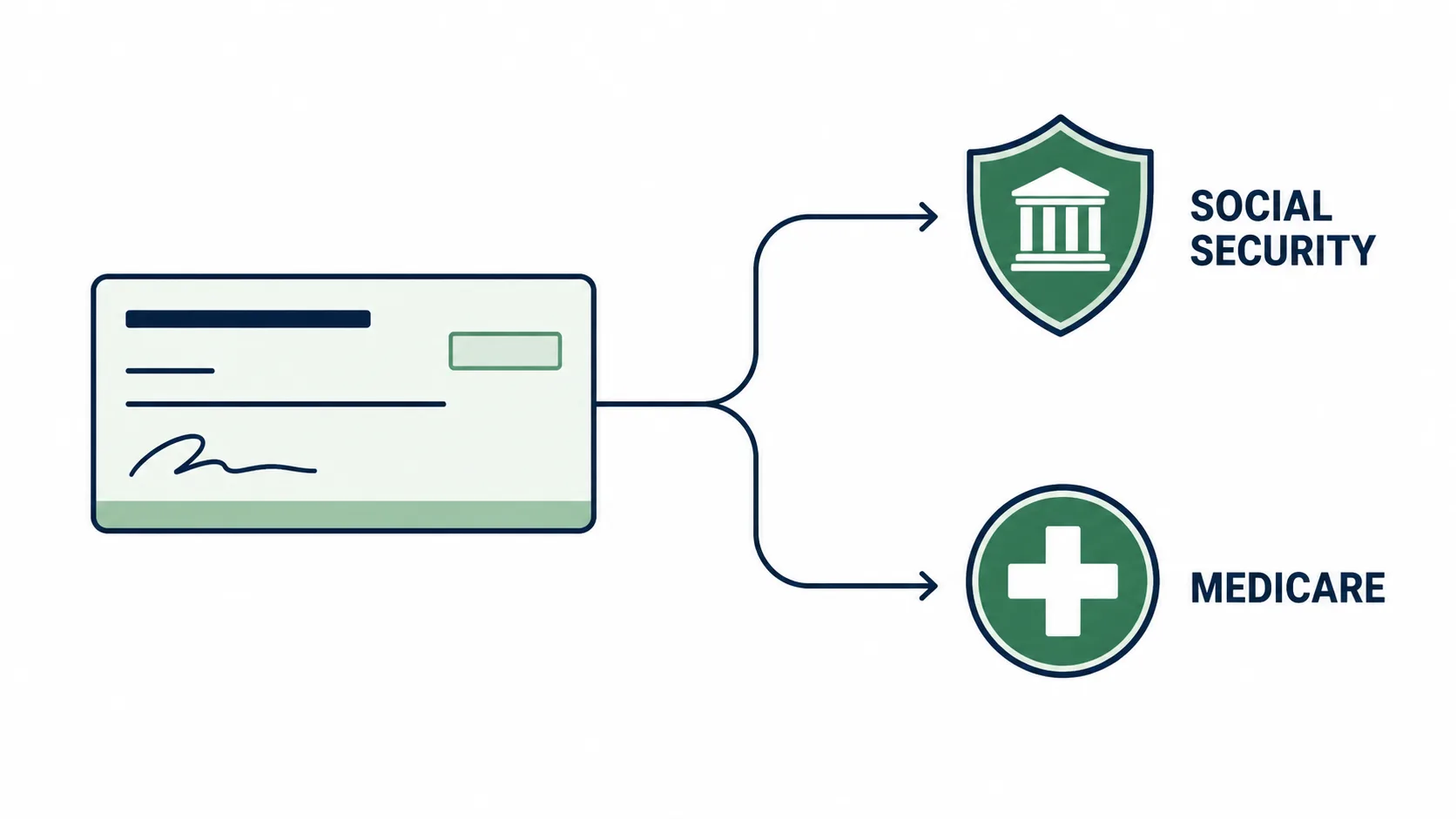
What FICA actually is comes down to one surprising fact: it’s not one tax, it’s two, bundled under a single line item on your paycheck. Most people know it’s a deduction; fewer know it’s actually two separate programs with completely different rules. Our Texas paycheck calculator breaks both of them out as separate line items, which makes the split a lot easier to see on an actual paycheck.
What FICA Actually Is, Broken Down
FICA stands for the Federal Insurance Contributions Act, the law that established these payroll taxes. It combines two distinct programs — Social Security and Medicare — each with its own tax rate and its own funding purpose, reported together as “FICA” on most pay stubs even though they fund entirely different things. That’s really what FICA actually is once you look past the combined line item: two unrelated programs sharing one name.
Social Security vs. Medicare, Side by Side
Social Security tax funds retirement, disability, and survivor benefits — the program most people think of when they picture “getting Social Security” after retiring. It’s withheld at a fixed 6.2% of wages up to an annual wage cap that adjusts yearly ($184,500 for 2026); income above that cap in a given year isn’t subject to additional Social Security tax, which is a detail that specifically matters for higher earners.
Medicare tax funds hospital insurance for people 65 and older (and some younger people with specific disabilities or conditions), withheld at its own fixed 1.45% — and unlike Social Security tax, Medicare tax has no wage cap; it applies to all earned income. Higher earners also pay an additional 0.9% Medicare tax above a certain income threshold, a provision added specifically to help fund the program from higher earners.
| Program | Employee Rate | Wage Cap (2026) | Funds |
|---|---|---|---|
| Social Security | 6.2% | $184,500 | Retirement, disability, survivor benefits |
| Medicare | 1.45% (+0.9% above threshold) | None | Hospital insurance (65+, some disabilities) |
| Combined FICA | 7.65% | N/A (blended) | Both programs above |
Background: Federal Insurance Contributions Act — Wikipedia
Why Your Employer Matches Every Dollar
Employers match the employee’s FICA contribution dollar-for-dollar — meaning for every dollar withheld from your paycheck for Social Security and Medicare, your employer pays an equal amount separately (this employer-side match doesn’t come out of your paycheck; it’s a separate employer cost). Self-employed workers, by contrast, pay both the employee and employer portions themselves through self-employment tax, which is why self-employment tax rates look higher than employee-side FICA at first glance — they’re covering both halves.
FICA is separate from federal income tax, even though both are withheld from the same paycheck and often discussed together casually. Federal income tax funds general government operations and is calculated based on your W-4 and tax bracket; FICA funds these two specific programs and is calculated as a fixed percentage regardless of your W-4 elections. Understanding what FICA actually is — versus income tax — is the difference between reading a pay stub and just glancing at it.
Our Texas paycheck calculator breaks out Social Security and Medicare as separate line items rather than combining them into one FICA total, so you can see exactly what each program is taking from a given paycheck.
Pay schedules are fundamentally a dates problem — see our Dates and Time Planning cluster →
Texas Paycheck Calculator
Run the actual numbers free, no signup required.
Related questions
What is FICA tax, in the simplest possible terms?
What FICA actually is comes down to a combined 7.65% payroll deduction — 6.2% for Social Security and 1.45% for Medicare — withheld from most U.S. paychecks and matched dollar-for-dollar by the employer.
What does each box on Form W-4 actually change about withholding?
The W-4’s steps adjust how much federal tax your employer withholds per paycheck — filing status sets your bracket, dependents reduce withholding, and the “extra withholding” field adds a flat additional amount on top of the calculated figure.
How does overtime pay actually get calculated under the FLSA?
Non-exempt hourly employees are entitled to 1.5x their regular rate for hours worked beyond 40 in a single workweek under federal law — salaried-exempt employees generally aren’t eligible for overtime at all, which is a key legal distinction.
Do pre-tax and post-tax deductions get taken out in a specific order?
Yes — pre-tax deductions (like traditional 401(k) contributions or health premiums) are subtracted before taxable income is calculated, which lowers your taxable wages; post-tax deductions come out afterward and don’t reduce what you’re taxed on.