
Birthstones and Birth Flowers: The Ultimate, Surprising 12-Month Guide
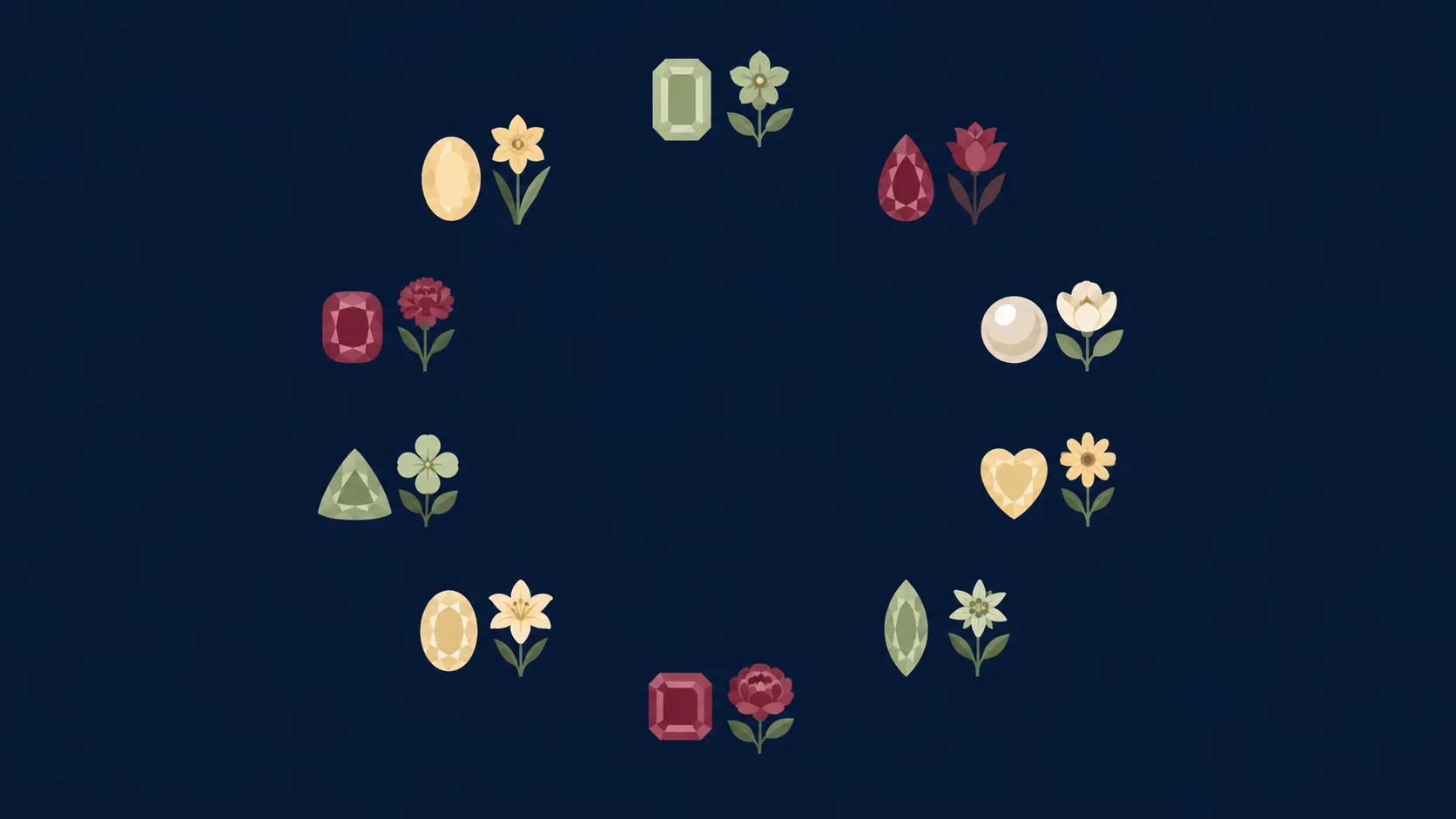
Birthstones and birth flowers feel ancient — the kind of tradition that must trace back centuries unbroken. Some of it does. A surprising amount of it doesn’t.
Where Birthstones and Birth Flowers Actually Came From
The idea of gemstones connected to months has genuinely old roots, often traced back to a first-century description by the historian Josephus linking twelve gemstones on a biblical high priest’s breastplate to the twelve months and zodiac signs. That’s a real ancient reference point — but the specific list of “January is garnet, February is amethyst” that most people know today is much newer than that.
The modern birthstone list was substantially standardized in 1912, when the National Association of Jewelers (in the US) formalized an official list — partly to settle inconsistencies between different regional and cultural birthstone traditions that had developed independently, and partly, candidly, because a standardized list was good for the jewelry trade. Several months have had their “official” stone changed or expanded since then; December, for instance, has picked up additional alternate stones over the decades.
Background: GIA — A Guide to Birthstones
How Birth Flower Traditions Differ From Birthstones
Birth flowers have a similarly mixed history. Some month-flower associations genuinely trace back to older European folk traditions and the Victorian-era “language of flowers,” where specific blooms carried symbolic meanings people used to send coded messages. But like birthstones, the specific list most commonly cited today wasn’t handed down as a single unbroken tradition — different sources give different flowers for the same month, because there was never one authoritative governing list the way there eventually was for gemstones.
None of this makes the tradition less genuine as a cultural practice — it’s just less ancient and more standardized-by-committee than the framing usually implies. Knowing that doesn’t take away from birthstones and birth flowers being a nice, personal detail people enjoy learning about themselves; it just puts the history in more accurate context.
So when someone asks what their birthstone or birth flower “really” means, the honest answer is layered: part ancient symbolism, part Victorian sentiment, part early-20th-century trade standardization. Birthstones and birth flowers are still a genuinely fun, personal way to mark a birth month — they’re just a newer tradition, in their current standardized form, than most people assume.
| Month | Birthstone | Birth Flower |
|---|---|---|
| January | Garnet | Carnation |
| February | Amethyst | Violet |
| March | Aquamarine | Daffodil |
| April | Diamond | Daisy |
| May | Emerald | Lily of the Valley |
| June | Pearl / Alexandrite | Rose |
| July | Ruby | Larkspur |
| August | Peridot | Gladiolus |
| September | Sapphire | Aster |
| October | Opal / Tourmaline | Marigold |
| November | Topaz / Citrine | Chrysanthemum |
| December | Turquoise / Zircon / Tanzanite | Narcissus / Holly |
Modern list per the 1912 Jewelers of America standardization, with later additions: GIA — A Guide to Birthstones
Our chronological age calculator surfaces your birthstone and birth flower automatically alongside your exact age — a small detail, but one a lot of people enjoy seeing paired with the harder numbers.
Age is ultimately a date-math problem — for more on how calendars and date calculations actually work, see our Dates and Time Planning cluster →
Chronological Age Calculator
Run the actual numbers free, no signup required.
Related questions
Does a leap year change how chronological age is calculated?
Yes, in a small but real way — someone born on February 29th technically only has a birthday every four years, and accurate age calculators handle this edge case explicitly rather than defaulting to March 1st or February 28th inconsistently.
Why do kindergarten cutoff dates vary so much between states?
Each U.S. state sets its own age-cutoff policy for school entry, generally somewhere between August and December of the enrollment year — there’s no federal standard, which is why the same child’s eligibility can differ significantly just by crossing a state line.
How are generational boundaries like Gen Z or Millennial actually decided?
Generational labels are typically defined by researchers (often Pew Research) based on shared formative events and birth-year ranges, not by any official government standard — which is why you’ll sometimes see slightly different year ranges depending on the source.