
Master Numbers 11, 22, 33 — Where the “Don’t Reduce Further” Rule Comes From
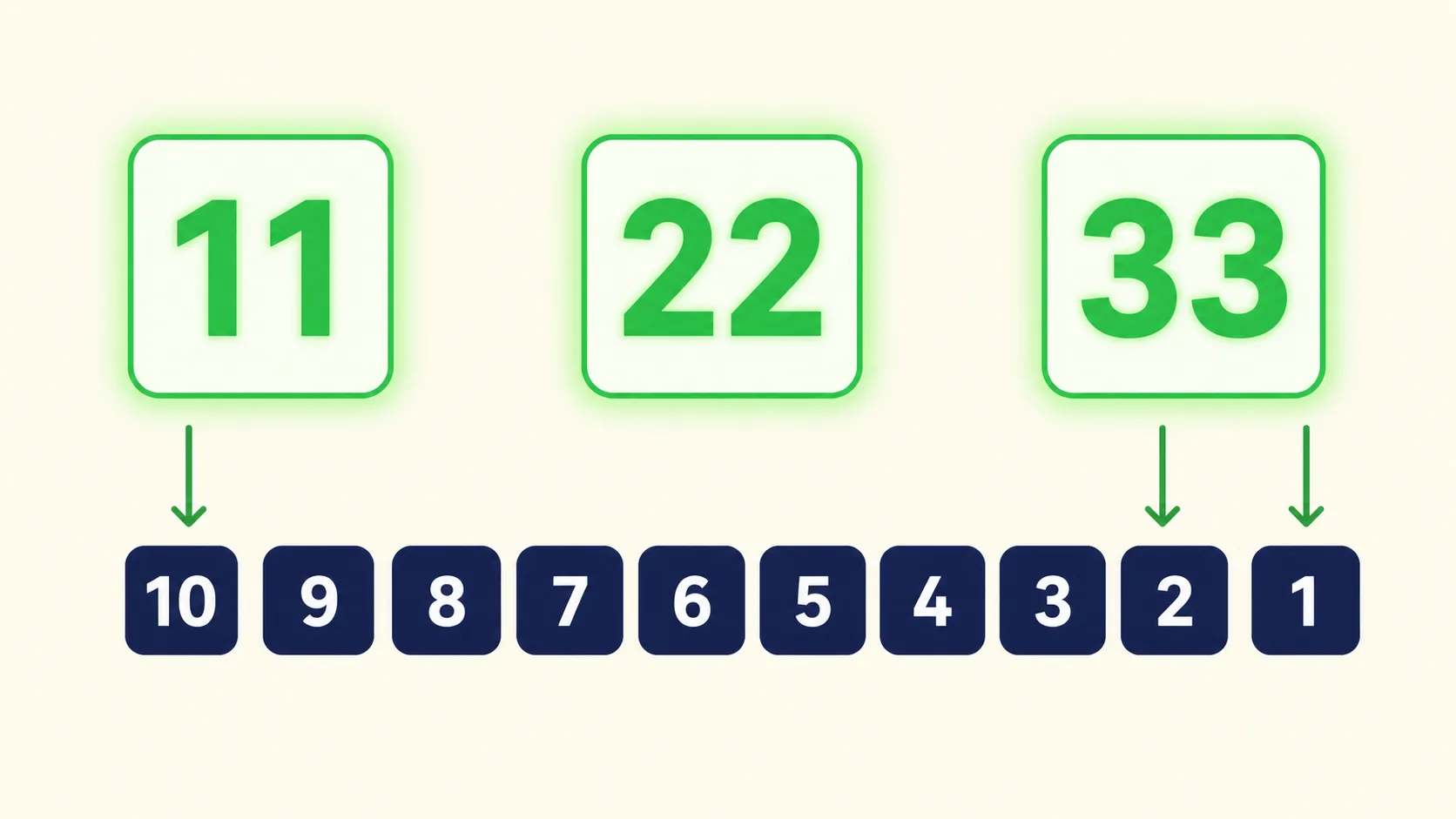
Master numbers 11, 22, and 33 are the one exception to how digital-root reduction normally works. If you’ve reduced a number down to its “digital root” before — repeatedly adding digits together until one remains — you’ve probably noticed the process sometimes stops early. A total of 74 becomes 7+4=11, and then… it just stops at 11, instead of continuing to 1+1=2. That’s not an error. It’s a deliberate rule.
What Master Numbers Are (and Why They Break the Pattern)
Numerology treats 11, 22, and 33 as “master numbers,” meaning they’re considered to carry their own significance and are traditionally left unreduced rather than collapsed to a single digit. This convention specifically comes out of Pythagorean numerology, the same alphabet-to-number reduction system used in most gematria-adjacent calculations. Every other double-digit total gets folded down; these three are the deliberate exceptions.
Each master number has a traditional association. 11 is tied to intuition and heightened perception — sometimes described as spiritual insight arriving faster than logical thought. 22 is described as the “master builder,” associated with turning ideas into large-scale, concrete results. 33 is the least commonly reached, since it requires a larger starting sum, and is associated with a kind of guidance or teaching role.
Why 11, 22, and 33 Don’t Get Reduced Further
The rule holds that reducing a master number further would erase meaning it’s supposed to represent on its own. 11 could technically continue to 1+1=2, 22 to 2+2=4, and 33 to 3+3=6 — and in practice those root digits (2, 4, 6) are still read as an undertone. But the tradition stops the reduction one step early specifically because the doubled digit is treated as more significant than its collapsed form.
Background: Numerology — Wikipedia
Why stop at 33 and not continue to 44, 55, and beyond? There’s no universal agreement here — some modern numerology systems do extend the list, but 11, 22, and 33 are the three that appear consistently across most traditional sources, likely because they were the ones most frequently reached from common calculations historically and gained cultural traction as a result.
It’s worth being upfront that this is an interpretive convention, not a mathematical rule. There’s nothing about the number 11 that’s inherently different from 12 in a mathematical sense — the “master number” designation is a layer of meaning added by numerological tradition, the same way certain numbers carry weight in gematria without that weight being provable.
Master Numbers 11, 22, 33 at a Glance
- 11 — reduces to 2: Intuition and heightened perception; often described as spiritual insight arriving faster than logical thought.
- 22 — reduces to 4: The “master builder” — turning ideas into large-scale, concrete results.
- 33 — reduces to 6: The rarest of the three to reach; associated with a guidance or teaching role.
- Everything else: Reduced normally to a single digit 1–9, no special status.
Our gematria calculator applies this master-number convention automatically in its digital root calculation, so if your word’s total reduces to 11, 22, or 33, it shows you that directly rather than continuing to reduce it down to a single digit.
Numbers show up everywhere on this site, not just in letter-values — our Age & Life Calculators cluster →
Gematria Calculator
Run the actual numbers free, no signup required.
Related questions
Do different gematria systems ever agree on the same word?
Occasionally, by coincidence, two systems land on the same total for a given word — but it’s not the norm. Because each system uses a different letter-to-number mapping, agreement across systems is the exception, not something to expect.
Did gematria exist before Hebrew tradition adopted it?
Letter-to-number systems appear independently in several ancient cultures. Greek isopsephy and Hebrew gematria developed the same core insight — that letters can double as numerals — around the same historical window, and scholars still debate how much either tradition influenced the other.
What are “master numbers” and does gematria use them?
Master numbers (11, 22, 33) come from numerology, where they’re treated as significant totals that shouldn’t be reduced to a single digit. Gematria itself doesn’t traditionally use this rule — it’s a numerology-specific concept that sometimes gets applied on top of a gematria calculation.