
Bonus Check Often Looks 30% Smaller Than Expected — Here’s Why
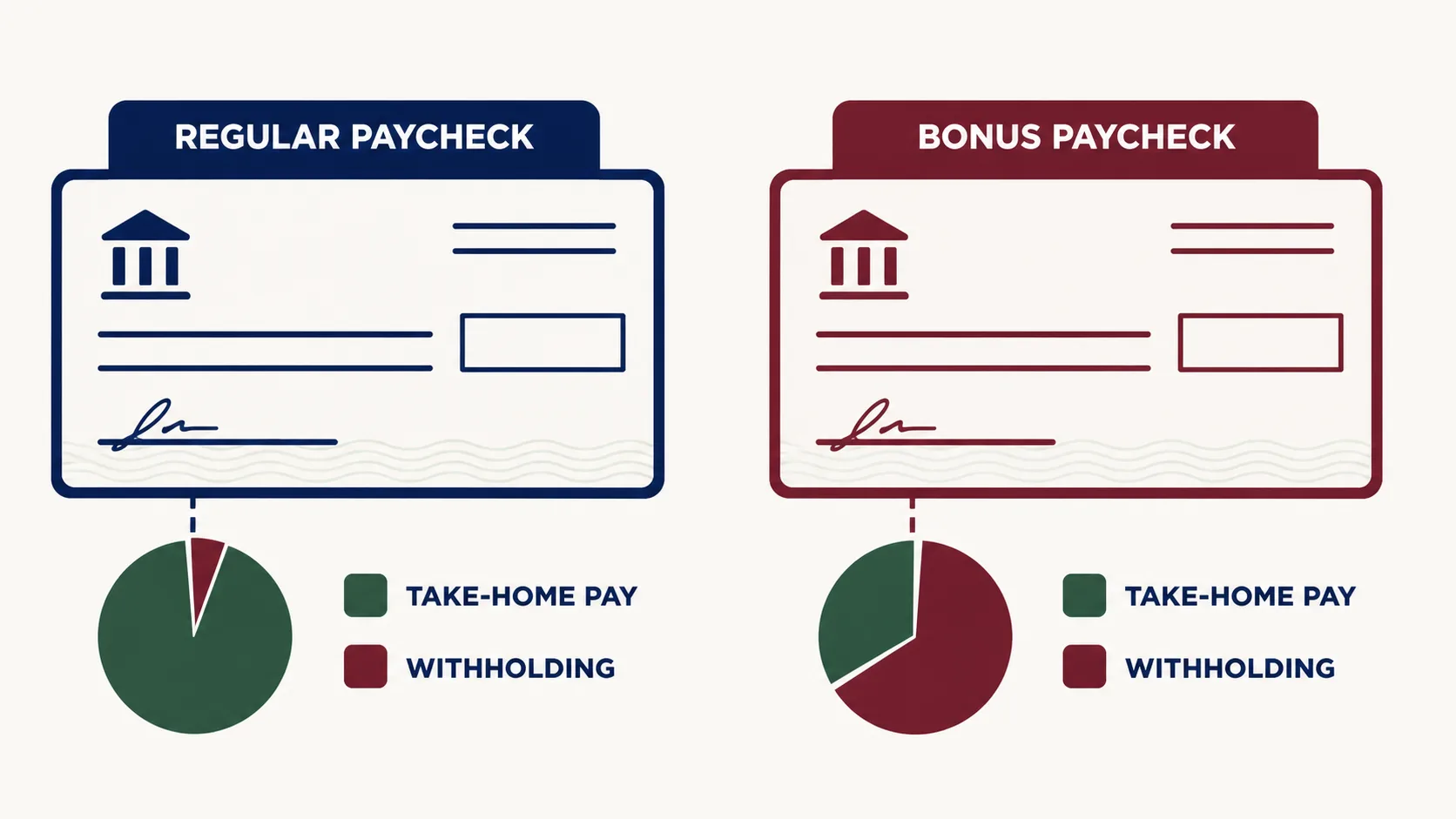
A bonus check often looks smaller than expected, and it’s rarely a mistake. A $1,000 bonus landing as $700-something in your account is one of the most common payroll surprises, and it leads almost everyone to the same wrong conclusion: that bonuses get taxed harder than a regular paycheck.
Why a Bonus Check Often Looks Smaller: The Percentage Method Explained
The IRS allows employers to withhold bonus income using one of two methods, and the “percentage method” is the one behind most of that smaller-than-expected number. Under this method, employers withhold a flat percentage from supplemental wages — bonuses, commissions, and similar payments — for federal purposes, a specific flat rate applies to most supplemental wages up to a certain amount, separate entirely from whatever your regular paycheck’s marginal tax bracket happens to be.
That flat rate is a withholding rate, not your actual tax rate. If your real marginal bracket is lower than the flat supplemental rate, the difference comes back to you as part of your refund when you file. A bonus check often looks smaller than expected simply because it’s withheld at a rate that doesn’t know your personal bracket, unlike your regular paycheck withholding, which is calculated using your actual W-4 elections.
According to IRS Publication 15 (Circular E), Employer’s Tax Guide, supplemental wages are defined separately from regular wages precisely so employers have a standardized flat-rate option for withholding on payments like bonuses.
Percentage Method vs. Aggregate Method: A Side-by-Side Look
Employers can choose either method — employees don’t typically get to pick. Here’s how the two diverge on the same bonus:
| Method | How It’s Calculated | Effect on This Paycheck |
|---|---|---|
| Percentage method | A flat federal rate applied only to the supplemental (bonus) amount, separate from your regular pay | The main reason a bonus check often looks smaller than expected on its own |
| Aggregate method | The bonus is combined with your regular paycheck for that period and withheld as one lump sum | Can push the withholding calculation into a higher bracket for that pay period only, since the combined total looks like a much bigger regular paycheck than it represents annually |
FICA taxes (Social Security and Medicare) apply to bonus income the same way they apply to regular wages, with no special flat rate — so part of the gap is completely ordinary payroll tax, not anything unique to bonus treatment.
Where the Extra Withholding Actually Gets Reconciled
None of this means bonuses are a bad deal — it just means the check you see reflects a withholding estimate, not necessarily your final tax liability on that money. The actual tax owed on a bonus gets reconciled the same way all your income does: when you file your return for the year, at your real marginal rate.
Our Texas paycheck calculator includes a dedicated bonus calculator that applies the standard federal supplemental withholding method automatically, so you can see a realistic net estimate before the bonus actually hits your account.
Pay schedules are fundamentally a dates problem — see our Dates and Time Planning cluster →
Texas Paycheck Calculator
Run the actual numbers free, no signup required.
Related questions
Why does a bonus check often look smaller than expected?
A bonus check often looks smaller than expected because it’s withheld at a flat federal supplemental rate that ignores your personal tax bracket, not because it’s actually taxed at a higher rate — the difference evens out at filing time.
What does FICA actually fund?
FICA taxes fund Social Security and Medicare — the money withheld from your paycheck today funds current beneficiaries’ benefits, under a pay-as-you-go structure, rather than being held in a personal account for you specifically.
What’s the real difference between biweekly and semi-monthly pay?
Biweekly pay happens every two weeks, producing 26 paychecks a year (occasionally 27); semi-monthly pay happens twice a month on fixed dates, producing exactly 24 paychecks a year — the per-check amount differs even for an identical annual salary.
Is a bonus actually taxed at a higher rate than regular pay?
No — the federal flat supplemental withholding rate is a withholding estimate, not a permanent tax rate. If your real marginal bracket is lower, you get the difference back as part of your refund when you file.